
Before logging in to Big Daddy, find out if it is credible!
In India, scammers use Telegram, WhatsApp, and VIP Agents to bait users into clicking malicious log in pages or downloading fake apps.
This guide will help you meet your login expectations through specific steps customized for India.
Tactics of Legitimate Viruses
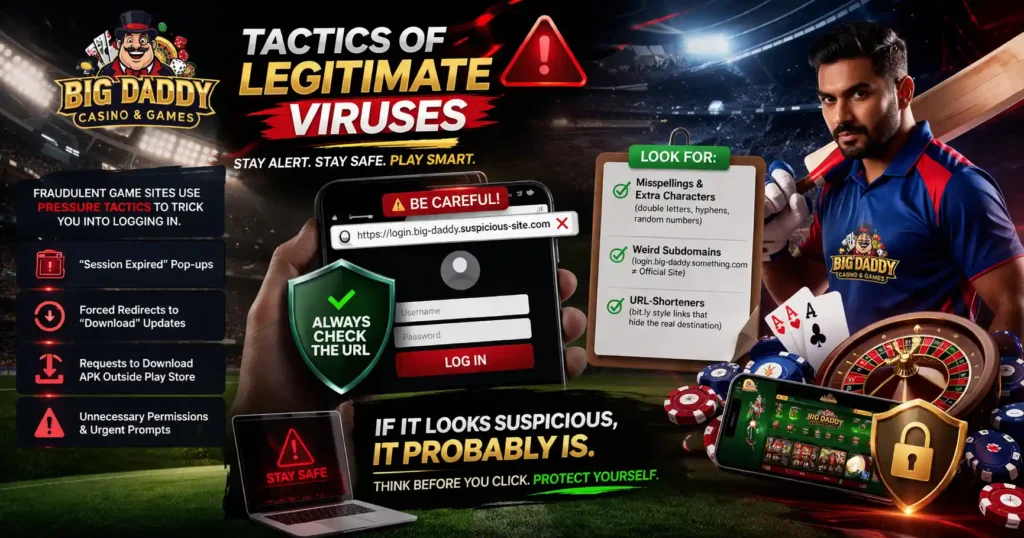
Legitimate log in pages are boring. They load directly to the log in page, do not request any additional permissions that a user hasn’t already given, and do not redirect to the download of an updated version of the app.
On the other hand, a game page that is fraudulent will use pressure tactics to get you to log in faster. You may see a “session expired” pop-up, a forced redirect to “download” the latest update or the app, or be asked to update to an APK version that is outside the Play Store.
If your link to Big Daddy was forwarded to you, take a moment to examine the page and link as if it were street food at the peak of summer.
Here is a quick test that many people skip, then regret later: Check the URL.
A good tip is to pay close attention to the URL and see the spelling of the UPI handle before logging in.
Look for:
- Misspellings and extra characters (double letters, hyphens, random numbers).
- Weird subdomains (like login.big-daddy.something.com when the brand claims a different main site).
- URL-shorteners (bit.ly style links) that hide the real destination.
A legitimate platform should not need to hide its identity behind an abbreviated link or a series of redirects. If you are constantly being redirected to different locations, you should close that website and find a safer entry point.
APK Warnings and Safer Options
“Install This APK” is Not a Feature. It’s a Warning Signal!
In India, one of the most prevalent traps of betting applications is the “quick install” file used to promote the newest version of the app.
If you are being asked to install an APK from an unknown source, you should take notice of what that request truly means: They want you to give them permission to place potentially dangerous software on your device. That’s not a problem you are having trying to log in; it’s a security issue for your device.
The safer option consists of:
- A recognised app store listing (or an established, vetted source).
- No time limitations (“Download in 5 minutes or miss out”).
- No “agent” telling you that you have to download their file to access your account.
Even if you only wanted to access Bigdaddy Game for one minute, the malware does not require that long to infect your phone – all it needs is one permission.
Security Checks That Matter
The Two-Sec Security Check: What Separates True from Fake
Your login process that is reliable will protect you even if you don’t pay attention!
Green flags:
- The availability of two-factor authentication (App-based or SMS, according to what they offer).
- The ability to log out on all other devices.
- Direct requests that never request your PIN or UPI PIN or complete OTP via text message, for verification.The following are all signs of a fraudulent website:
- Pop-up message that states: “Please provide OTP to continue with withdrawal process.”
- Customer support employee asking you for your password.
- Login screen accepting ridiculously weak passwords and not warning you
Legitimate websites may later ask for personal identifying (KYC) information; they will
NEVER ask you for your KYC information at the time of your withdrawal when it will allow access to your account to remove all your funds.
Withdrawal Terms and Red Flags
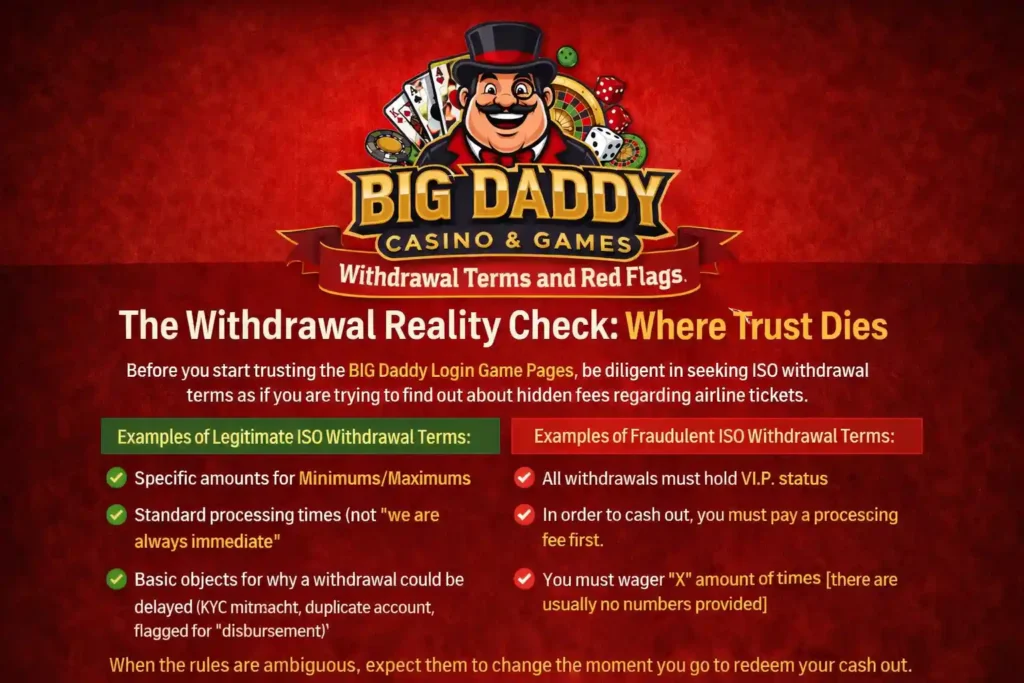
The Withdrawal Reality Check: Where Trust Dies
Most scams do not commence with deposits. Most continue with the withdrawal phase before any account may be trusted as legitimate.
Before you start trusting the BIG Daddy Login Game Pages, be diligent in seeking ISO withdrawal terms as if you are trying to find out about hidden fees regarding airline tickets.
Examples of Legitimate ISO Withdrawal Terms:
- Specific amounts for Minimums/Maximums
- Standard processing times (not “we are always immediate
- Basic objects a withdrawal could be delayed (KYC mismatch, duplicate account, flagged for “disbursement”)
Examples of Fraudulent ISO Withdrawal Terms:
- All withdrawals must hold VI.P. status
- In order to cash out, you must pay a processing fee first.
- You must wager “X” amount of times [there are usually no numbers provided]
When the rules are ambiguous, expect them to change the moment you go to redeem your cash out.
UPI Payment Method Traps
UPI Payment Methods Traps Are Coming From Places You Didn’t Expect:
UPI is a form of payment methods; however, it is mostly recognized as a reliable form of payment in India. Therefore, scammers have taken full advantage of the Indians’ assumptions.
A reliable company will NEVER have you use their personal UPI account (which appears to be a personal name) for sending your funds. They also will NEVER change the name of their beneficiary account weekly.Signs of trouble with deposits:
- ‘Send this amount to this UPI and take a screenshot of the transaction with WhatsApp’
- ‘Use this exact QR code for the deposit, as it will expire in three minutes’
- ‘You will not receive an in-app receipt for your payment and the only confirmation you will receive is via chat’
If you see any of these signs during the process of accessing big daddy’s game then the system you are dealing with is not secure. You are dealing with a manual process, which is not an automated system.
Customer Support and KYC
When You Ask a Real Question, Customer Support Disappears
You can easily test if a site has good customer service, by messaging the customer support team before making a deposit.
You can ask a question that is important and direct but not too complicated:
- “What types of KYC documents do you accept for Indian customers?”
- “What is your withdrawal processing time during weekend?”
- “How do I reset my password if I don’t have OTP access?”
Good customer service will respond to your questions clearly without trying to push you off into an agent’s private chat in Telegram.
Bad customer service will try to create pressure, send you copy-pasted responses or ask for your mobile number and OTP code in order to “verify” you.
If you can only reach customer service through a Telegram messenger account that keeps changing their user names, that is not customer service. You are dealing with a trap door.
KYC and Privacy: The Real Fear of Aadhaar
When using real money gambling websites or applications, you normally will be asked to create an account using KYC and identity verification processes.The real issue is how the data is being collected and stored.
Some good signs are:
- Clear and easy-to-read privacy policies explaining how you will use the data and how long you will keep it.
- Secure uploads of required documents through our mobile app or website (and NOT having to send them via WhatsApp).
- A complete and specific list of all documents that you need to give us (not “any form of ID”).
Some bad signs are:
- Asking customers for their Aadhaar card both front and back, taking a selfie of their face, and doing “video verification” through a random link.
- Telling people that they will lose their ability to access their Cricket ID until they provide the required documents.
- Threatening to freeze their account if they do not send the required documents within 10 minutes.
The goal of KYC is not to make it seem intimidating or like a form of blackmail, but rather to provide customers with an experience that is similar to completing forms for opening bank accounts.
Cricket Keywords and Bonus Traps
The Cricket Angle – When “Online Cricket ID” Becomes a Target for Scammers.
Many people search for the login to their favourite cricket games because they want to keep up with games, betting, and scores. Scammers are using keywords like:
- cricket betting app
- online cricket id
- bet online cricket
- cricket bet online
- online bet on cricket
- online cricket betting
- cricket bet
- Online betting Id
- cricket betting sites
If a website is loaded with these keywords, and it doesn’t provide clarity about the owner’s identity, the rules, or the availability of customer service, then it is more than likely a content farm trying to achieve high rankings through internet search engines, rather than a legitimate business.
A legitimate business will provide its customers with information about its products before trying to sell the customer anything. A scam will attempt to sell the customer before explaining anything about the product.
***”Teen Patti Real Cash” Promo Marketing – The Bonus Trap***
Bonuses are typically the loudest type of bait that scammers use.If a site combines a tough-to-find teen patti real cash package with aggressive bonus offers then you should be cautious about what the website has to offer. Wagering requirements or “suspicious play” rules many times prevent users from collecting their bonuses.
Look for:
- Exact percentage of bonus
- Maximum bonus amount allowed
- Play-through requirements listed numerically
- What happens if you withdraw before hitting the total amount
If the bonus offer doesn’t give you numbers, it was designed to confuse you.
Identity and Password Reset
The Identity Check: Who’s Behind This Operation?
Even if you’re not interested in who owns what, a reputable site has a trail to follow.
What you should be looking for (without having to play detective):
- Company name or operator info
- Terms and Conditions that are more than a paragraph long
- An email support address matching the domain of the website (not a free Gmail address for support)
If the operator of a site hides behind a generic name, you could lose access to your funds at any time and be left with nothing to show for it other than an image of a logo.
Password Reset: The Opportunity for Scammers
Many users fall victim to phishing schemes during a password reset rather than logging in.Authentic Reset Process:
- Confirms via the registered email/phone number.
- Allows you to regain access to the account without having to get an OTP through a support chat agent.
- Sends confirmations for account changes via email.
Fraudulent Reset Processes:
- Forces you to send a message to an agent.
- Requests an OTP to “confirm your identity.”
- Requests a screenshot of recent deposits to “confirm your identity.”
Never give out an OTP that was not done within an official process. Do not send it to anyone! Friends, support, anyone with a logo on their profile.
Checklist, Damage Control, Focus
“There is a one-page checklist you should use every time.”
If you need to double-check anything before you type your credentials into a large login page, use this mental list:
- Do I trust how I got to this Page (not forwarded)?
- Does the URL appear clean and consistent?
- Does everything about the login process seem normal? No forced downloads?
- Does the withdrawal process have solid supporting information regarding amounts and timeframes?
- Can I reach support without dealing with agents or DMs?
- Do I see strange permissions when using the app?
- Are the payment instructions automated and traceable?
If 2 answers or more make you feel uncertain or uneasy, DO NOT sign in!! The decision that prevents a headache later is the right decision!!!
If You have Signed in to A Potential Scam: Damage Control With NO DRAMA!
If you think you may have entered your credentials incorrectly, MOVE FAST and make it simple to correct!!!
- Change your password on the genuine platform (from a properly established entry).
- Enable 2FA (if available on the platform).
- Log out of ALL devices if that option is available.
- Check your banking/UPI history for transactions that are unfamiliar.
- If you have reused passwords on other platforms change those passwords as well.
Scams escalate quickly because of people’s actions of password reuse, delaying action, and taking little steps to fix issues. Taking care of it ASAP will result in saving you time, trouble, and headache.
The ONE question you should focus on!
Although a platform may appear flashy, run quickly, and be set up to steal your money at the very first opportunity that you try to withdraw.
When checking for trusted signals while logging into big daddy games don’t look at design, look at the following behaviors: URLs, Permissions, Quality of Supporting staff, and Withdrawal Information.
If the platform appears to hide something, TRUST YOUR INSTINCT. This is NOT paranoia, it is assignment Recognition due to the daily headlines regarding online fraud in America.